

Chueca’s Architectural Gems: Modernist Masterpieces, Stately Palaces, and Open House Madrid Tours
Table of Contents
Introduction: The Splendor of Chueca Architecture and Open House Madrid
As September draws to a close, the Spanish capital celebrates its grand festival of built heritage with the international Open House Madrid festival, placing Chueca’s architecture at the center of attention. Far from being merely a cosmopolitan hub for leisure and gastronomy, the Chueca neighborhood and its borders with Salesas and Justicia are home to one of Madrid’s most valuable collections of residential, noble, and institutional buildings. Exploring Chueca architecture during these autumn days offers extraordinary access to private interior courtyards, protected palaces, and historic rooftops that are usually closed to the public.
The urban physiognomy of the neighborhood is the result of successive historical layers that harmoniously coexist. Analyzing Chueca architecture means contemplating everything from 16th-century Renaissance constructions to daring Art Nouveau experiments from the early 20th century and contemporary bioclimatic architectural works. Those who appreciate Chueca’s architecture will discover a catalog of biomorphic moldings, wrought-iron balconies, white wooden bay windows, and granite ashlar portals on every facade. This constructive melting pot transforms Chueca’s architecture into an open book on Madrid’s urban transformation.
In this specialized guide, we break down the 7 essential stops to marvel at Chueca’s architecture with complete freedom of movement, lightness, and comfort.
Modernist Architecture in Chueca: The Fantasy of Palacio de Longoria.
The undisputed jewel and most celebrated landmark when discussing Chueca architecture is the Palacio Longoria, located at the confluence of Fernando VI and Pelayo streets.
Designed in 1902 by architect José Grases Riera as a residence for the financier Javier González Longoria, this palace stands as a masterpiece of Catalan and international Modernism in Madrid, greatly enriching Chueca’s architecture. Its facade, sculpted in fluid artificial stone, replete with acanthus leaves, intertwined vegetal stems, and Symbolist-inspired female faces, places Chueca’s architecture on the same artistic level as contemporary buildings in Brussels, Paris, or Barcelona. Inside, the historical headquarters of SGAE, the imposing imperial iron and marble staircase crowned by a dome of polychrome stained glass from the Maumejean house dazzles those who study Chueca’s architecture.
Special Open House Madrid tours allow visitors to contemplate this unique interior space, reaffirming the exceptionality of Chueca’s architecture.
During the Open House Madrid festival, registered architects, art historians, and specialized volunteers guide small groups through the entrance halls, vaulted basements, and upper galleries of normally inaccessible properties. These guided tours allow visitors to unravel the construction techniques of the era, the introduction of the first cast-iron structures compared to traditional Valsaín pine wood frameworks, and the energy efficiency projects currently being implemented to rehabilitate protected estates without altering their heritage value.
The Enigmatic House of the Seven Chimneys in Plaza del Rey.
At the southern end of the neighborhood, presiding over Plaza del Rey, stands one of the oldest and most intriguing Renaissance testaments to Chueca’s architecture: the House of the Seven Chimneys.
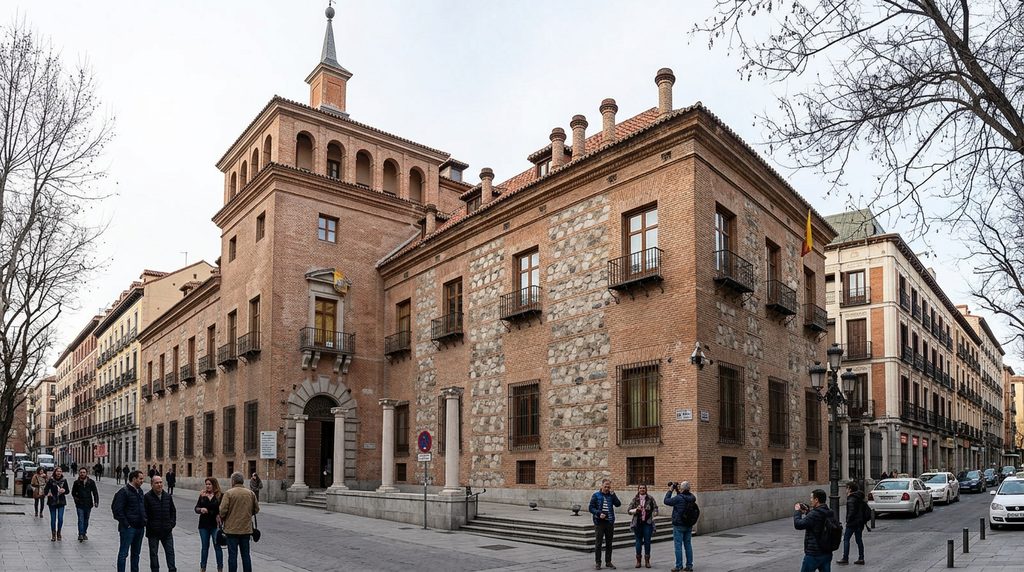
Built at the end of the 16th century by Antonio Sillero and later reformed by Juan de Herrera, this noble mansion represents an austere example of the neighborhood’s built heritage preceding courtly Baroque. Its Toledo brick facade with ashlar masonry, its hipped roof, and the seven cylindrical chimneys crowning the roof have fueled urban legends about the court of Philip II, adding mystery to Chueca’s architecture. Currently housing the Ministry of Culture, this building is a reference point for understanding how the architectural landscape evolved from the origins of the capital city.
Strolling through the square, observing the Herrerian proportions of its walls, reveals the monumental sobriety that also defines Chueca’s architecture.
The ornamental detail of the ironwork and artistic forging deserves a separate chapter in any visual itinerary through the neighborhood. Late 19th-century Madrid blacksmiths created entrance gates, helical railings, and eaves crests that display stylized floral motifs, volutes, and classical-inspired mascarons. Pausing to contemplate the portals on San Marcos, Infantas, or Colmenares streets allows one to appreciate how the manual work of cast iron added a seal of distinction and durability to each property, transforming a purely functional constructive element into a genuine piece of applied sculpture.
Grand 19th-Century Palaces and Apartment Buildings on Fernando VI.
Fernando VI street and its surrounding lanes concentrate the aristocratic legacy of 19th-century urban expansion, solidifying the bourgeois elegance of Chueca’s architecture.
Along this cobbled boulevard, five-story stately estates with wrought-iron and wooden glass bay windows exemplify the best of Chueca’s architecture from the Restoration era. Enclaves such as the Palacio de Santa Bárbara, in a French Neo-Rationalist style, showcase the residential refinement of Chueca’s architecture with its cobblestone carriage courtyards and large cast-iron gates. Lovers of historical urbanism value the architectural landscape for the quality of its stately portals clad in Spanish marble and traditional tile skirting.
This stately urban landscape demonstrates that Chueca’s architecture perfectly combines noble monumentality with neighborhood livability.
Among the classical palaces and stately estates, outstanding examples of traditional Madrid popular architecture survive, embodied in the traditional ‘casas a la malicia’ and ‘patios de corrala’. Originating during the 16th and 17th centuries as an ingenious neighborhood resource to circumvent the ‘regalía de aposento’ (billeting privilege) imposed by the Crown, these constructions concealed habitable floors behind modest-looking asymmetrical facades. Over the centuries, many of these estates evolved into corridor houses with wooden galleries and communal courtyards that have now been meticulously restored, preserving the social and working-class memory that gave rise to the district’s urban fabric.
Religious Architecture in Chueca: The Convent of Las Mercedarias de Góngora.
The sacred heritage adds a serene and monumental dimension that significantly enriches the understanding of Chueca’s architecture.
The Convent of the Discalced Mercedarias of the Immaculate Conception, known as Las Góngoras and located on Luis de Góngora street, is an excellent example of 17th-century Madrid Baroque that beautifies Chueca’s architecture. Designed by Fray Manuel de San Juan Bautista, the temple stands out for its sober brick and granite facade, its Latin cross plan, and its dome on pendentives, constituting a very peaceful stop within Chueca’s architecture. Discovering this cloistered corner allows visitors to disconnect from the commercial bustle and connect with the conventual roots of Chueca’s architecture.
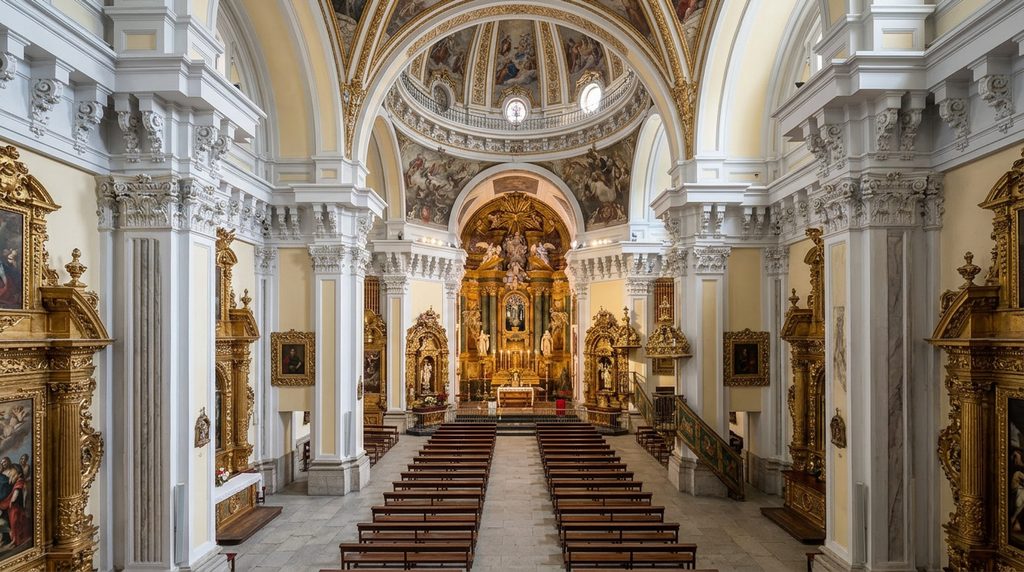
The impeccable preservation of its Baroque structure consolidates this temple as an essential piece of the area’s historical heritage.
Sustainable Vanguard and Urban Renewal in San Antón Market.
Contemporaneity and sustainable reconversion represent the most innovative and functional chapter of Chueca’s architecture.
The current San Antón Market, reopened on Augusto Figueroa street after an ambitious bioclimatic reconstruction project, illustrates the modern adaptation of Chueca’s architecture. Its rustic exposed brick structure, large cast-glass windows, and its solar thermal energy system reflect the ecological commitment of Chueca’s architecture. On its top floor, the elevated garden terrace overlooking the historic fabric allows one to contemplate Arab tile roofs and traditional chimneys, offering a privileged viewpoint over Chueca’s architecture.
This dialogue between the preservation of traditional commerce and ecological design defines the current direction of Chueca’s architecture.
Likewise, glazed tile skirting from the Talavera de la Reina potteries and the Moncloa factory enrich the portals of estates built between 1880 and 1920. Heraldic motifs, Greco-Roman mythological scenes, and geometric friezes in cobalt, ocher, and emerald green tones decorate the common areas of these bourgeois homes, conceived as prestigious antechambers to impress visitors before accessing the main high-ceilinged residences with plaster moldings.
Practical Guide to Urban Mobility in the Centro District.
Chueca’s layout is subject to strict pedestrianization and low-emission measures. Planning your walking routes optimizes your visit to Chueca’s architecture.
| Transport / Service | Recommended Options | Advantages for Exploring Chueca Architecture |
| Madrid Metro | Chueca Station (Line 5). Nearby: Tribunal (L1, L10) and Gran Vía (L1, L5). | Direct access to the heart of Chueca’s architecture. |
| Urban Buses (EMT) | Lines 001, 002 (free), 1, 2, 46, and 74. | Nimble connections between the neighborhood’s built heritage landmarks. |
| Walking | Single-platform streets in Pelayo, Hortaleza, and Barquillo. | The best way to photograph Chueca’s architecture. |
| Smart Lockers | Locking Chueca (24/7 automated service). | Maximum physical lightness to admire the architectural landscape. |
Walking the streets in comfortable footwear allows you to notice the details of the wrought ironwork, eaves, and knockers that distinguish Chueca’s architecture.
Conclusion: Explore Chueca Architecture Burden-Free with Locking.
Visiting historic palaces during Open House Madrid, contemplating Longoria’s modernist dome, exploring Baroque convents, or ascending to panoramic rooftops requires complete freedom and physical agility. To fully enjoy Chueca’s architecture, dragging wheeled suitcases through cobblestone streets or carrying heavy backpacks and cameras up narrow staircases is extremely uncomfortable.
So that your sole focus is photographing and enjoying the fascinating Chueca architecture, Locking offers you the leading network of automated lockers and smart luggage storage in central Madrid. Our facilities are strategically located just a few meters from Chueca Metro station and Gran Vía, allowing you to book your locker 100% digitally, quickly, and securely in under 30 seconds.
If you’re visiting Madrid during the big architecture weekend or have a few free hours before heading to the train station or airport, we recommend booking your luggage storage in Chueca with Locking, leaving your belongings in a secure space, and admiring all the beauty of Chueca’s architecture with absolute freedom, lightness, and comfort!