


La Latina Architecture: 7 Historic Gems – Medieval Walls, Corralas, Mudéjar Towers & Palaces.
Table of Contents
Introduction: The Architectural Heritage and Architecture in La Latina.
In mid-November, when the crisp, oblique light of Madrid’s autumn clearly outlines brick cornices and centuries-old rooftops, contemplating the neighborhood’s built heritage becomes one of the most enriching cultural experiences in the entire capital. This district, built upon the foundational core of ancient medieval Mayrit, preserves a unique architectural showcase where sections of Andalusian fortifications, Mudéjar temples, Renaissance mansions, and traditional corridor-style homes coexist. Exploring the key landmarks of architecture in La Latina during these weeks allows visitors to read Madrid’s urban evolution directly on its rough stone, adobe, and Toledo brick walls.
The organic layout of its narrow streets, adapted to the natural hills descending towards the Manzanares River valley, invites you to walk at a leisurely pace, looking up at wrought-iron balconies and carved wooden eaves. Admiring the neighborhood’s built heritage means discovering how the stately austerity of the Hapsburgs dialogues with the communal functionality of old tenement houses. Those who choose to delve into the architecture in La Latina will find a living heritage that remains inhabited and vibrant in every cobblestone square. This historic mosaic establishes the architecture in La Latina as an essential route for art lovers, students, and curious travelers.
In this dedicated guide, we break down the 7 fundamental jewels so you can discover all the beauty of Madrid’s urban landscape with absolute freedom of movement, lightness, and comfort.
The Remains of the Islamic and Christian Wall on Cuesta de la Vega.
The chronological starting point for understanding the city’s defensive origin lies in the fortified sections that mark the beginning of Madrid’s urban landscape.
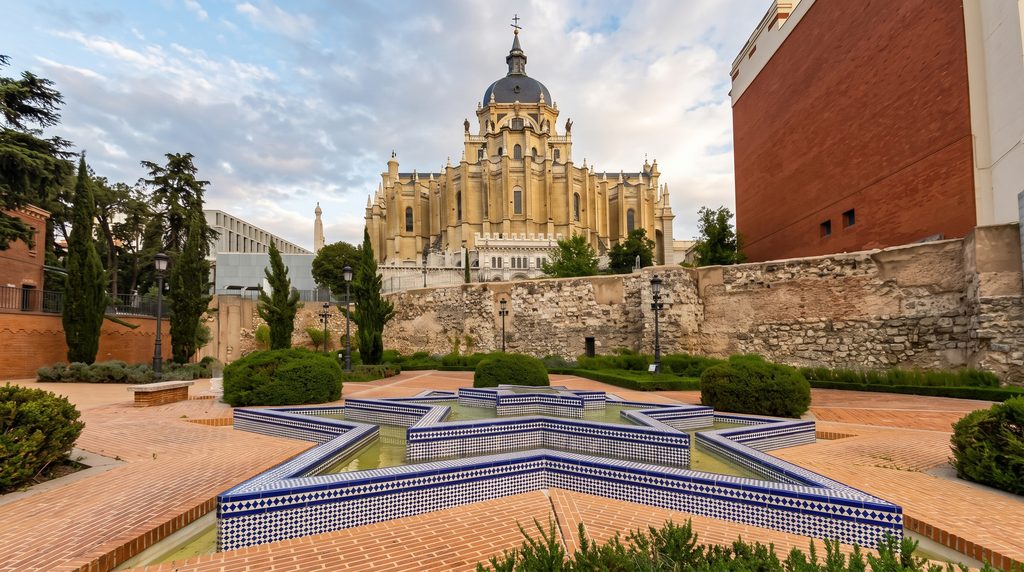
In the Parque Emir Mohamed I, next to Cuesta de la Vega, stand the remains of the wall built in the 9th century by order of the Cordoban emir, the primordial foundation of the neighborhood’s built heritage. Constructed from ashlar blocks of limestone and flint with header-and-stretcher bonding, this fortification protected the original citadel and defined the subsequent evolution of architecture in La Latina. A few meters away, in the streets of Segovia, Mancebos, and Cava Baja, fragments of the second Christian wall from the 12th century emerge, integrated into party walls and basements, evidencing the historical superposition of architecture in La Latina.
Contemplating these millenary open-air walls directly connects visitors with the medieval roots of Madrid’s urban landscape.
The construction technique employed by Andalusian master builders combined the solidity of flint stone extracted from local quarries with highly resistant lime mortars, creating walls capable of withstanding prolonged sieges and serving centuries later as foundations for the civil dwellings of the arrabal.
The Traditional Corralas of Calle del Tribulete and Mesón de Paredes.
The most traditional and representative residential typology of popular Madrid constitutes one of the most endearing chapters of Madrid’s urban landscape.
Emerged between the 17th and 19th centuries to accommodate the rapid demographic growth of the court, corralas are buildings organized around an open inner courtyard with wooden galleries featuring iron railings or turned balusters, an unmistakable hallmark of the architecture in La Latina. Famous examples such as the corrala on Calle del Tribulete or those located on Sombrerete and Mesón de Paredes show how this design favored cross-ventilation and community life in the architecture in La Latina. Respectfully peeking into their courtyards allows one to admire Valsaín pine pilasters, cobbled floors, and communal wells that humanize the architecture in La Latina.
The perfect climatic and social adaptation of these constructions makes the corralas an ethnographic treasure within the architecture in La Latina.
Mudéjar Art in the Towers of San Pedro el Viejo and San Nicolás.
The artisan imprint of Moorish master builders shines in the oldest religious bell towers that define the skyline of architecture in La Latina.
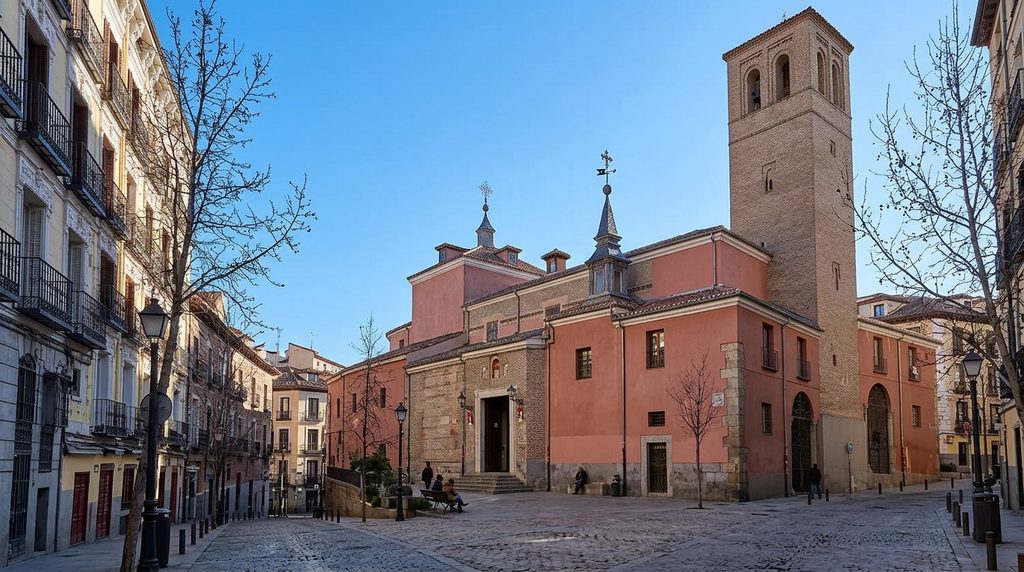
On Costanilla de San Pedro stands the tower of the church of San Pedro el Viejo, a slender 14th-century construction with exposed brickwork and blind horseshoe arches, representing the sacred peak of architecture in La Latina. Very close, on the northern edge towards Plaza de la Villa, the church of San Nicolás de los Servitas displays the oldest Mudéjar minaret in the town, a testament to the aesthetic persistence that distinguishes architecture in La Latina. Observing the geometric interplay of its brick-tooth friezes under the low November light enriches any tour dedicated to the architecture in La Latina.
The chromatic sobriety of the fired brick and the Austrian-style slate spire define the classic silhouette of architecture in La Latina.
Likewise, the interior Mudejar-style roof structures (‘par y nudillo’) crafted from resinous woods demonstrate the mastery of ‘white carpentry’ developed by local guilds during the Late Middle Ages.
Noble Palaces and Manor Houses in Plaza de la Paja.
During the 15th and 16th centuries, the most influential aristocratic families established their courtly residences around Plaza de la Paja, elevating the prestige of architecture in La Latina.
Historic properties such as the Palacio de los Vargas, the Palacio del Príncipe de Anglona, and the adjacent Capilla del Obispo display granite lintel doorways, stone-carved heraldic shields, and Renaissance-style arcaded courtyards that ennoble the architecture in La Latina. In particular, the Capilla del Obispo stands out for housing the only complete Plateresque altarpiece preserved in the capital, in addition to walnut doors carved with biblical scenes that are a masterpiece of architecture in La Latina. Strolling through this monumental complex allows visitors to appreciate the transition from late Gothic to Herrerian classicism within the architecture in La Latina.
The balance of proportions and the use of noble materials consolidate this square as the seigneurial hall of architecture in La Latina.
The Monumental Dome of the Royal Basilica of San Francisco el Grande.
At the western edge of the neighborhood stands the city’s most imposing Neoclassical temple, a monumental finishing touch to the architecture in La Latina.
Designed in the second half of the 18th century by Francisco Cabezas and completed by Francesco Sabatini, the Royal Basilica of San Francisco el Grande dazzles with its circular plan crowned by a thirty-three-meter diameter dome, the fourth largest in Christendom and the supreme jewel of architecture in La Latina. Its convex facade of granite ashlar with superimposed classical orders presides over the eponymous square, projecting an enlightened solemnity within the architecture in La Latina. Inside, mural paintings and canvases by Goya and Zurbarán complete the spatial splendor of this pinnacle of architecture in La Latina.
Contemplating the geometric assertiveness of its drum from the adjacent gardens provides a masterful conclusion to the study of architecture in La Latina.
Practical Guide to Urban Mobility in the Old Quarter.
The Central district prioritizes pedestrian movement and clean public transport (Low Emission Zone – Madrid Central). Organizing your routes optimizes your architectural exploration in La Latina.
| Transport / Service | Recommended Options | Advantages for Exploring Architecture in La Latina |
| Madrid Metro | La Latina Station (Line 5). Nearby: Tirso de Molina (L1) and Puerta de Toledo (L5). | Direct access to key architectural monuments in La Latina. |
| City Buses (EMT) | Lines 3, 17, 18, 23, 31, 35, 60 and 148. | Agile connections between the slopes and squares of La Latina’s architecture. |
| Walking Tour | Single-platform streets in Almendro, Nuncio, and Costanilla de San Pedro. | The ideal way to observe facades and details of La Latina’s architecture. |
| Smart Luggage Storage | Locking La Latina (24/7 Automated Service). | Maximum physical lightness for exploring La Latina’s architecture. |
Walking with comfortable footwear allows you to ascend the cobbled streets and stop to photograph doorways at your leisure during your route through the architecture in La Latina.
Conclusion: Explore La Latina’s Architecture Without Burden with Locking.
Exploring the steep slopes of the Morería, peeking into traditional corralas, admiring the Mudéjar towers, or visiting the majestic Basilica of San Francisco el Grande demands complete physical agility and freedom of movement. To fully immerse yourself in the visual discovery offered by the fascinating architecture in La Latina, carrying bulky wheeled suitcases, heavy travel backpacks, or shopping bags is extremely uncomfortable on the cobbled pavement and in narrow monumental accesses.
So that your only occupation is to admire every constructive and photographic detail of the fascinating architecture in La Latina, Locking offers you the leading network of automatic lockers and smart luggage storage in the center of Madrid. Our facilities are strategically located just a few meters from La Latina Metro station and Plaza de la Cebada, allowing you to book your space 100% digitally, quickly, and securely in less than 30 seconds.
If you visit Madrid during this peaceful November or have a few free hours before traveling after an inspiring heritage route, we recommend you book your luggage storage in La Latina with Locking, leave your belongings in a safe space, and experience all the history and beauty of the architecture in La Latina with absolute freedom, lightness, and comfort!